Online cartomancy with professional cartomancers
Cartomancy uses classic playing card decks (32 or 52 cards) or specialized oracles to shed light on a question. Distinct from tarot, it relies on a more direct and folk-rooted reading of traditional cards. Consult our cartomancers via chat or phone — no subscription.
View available practitioners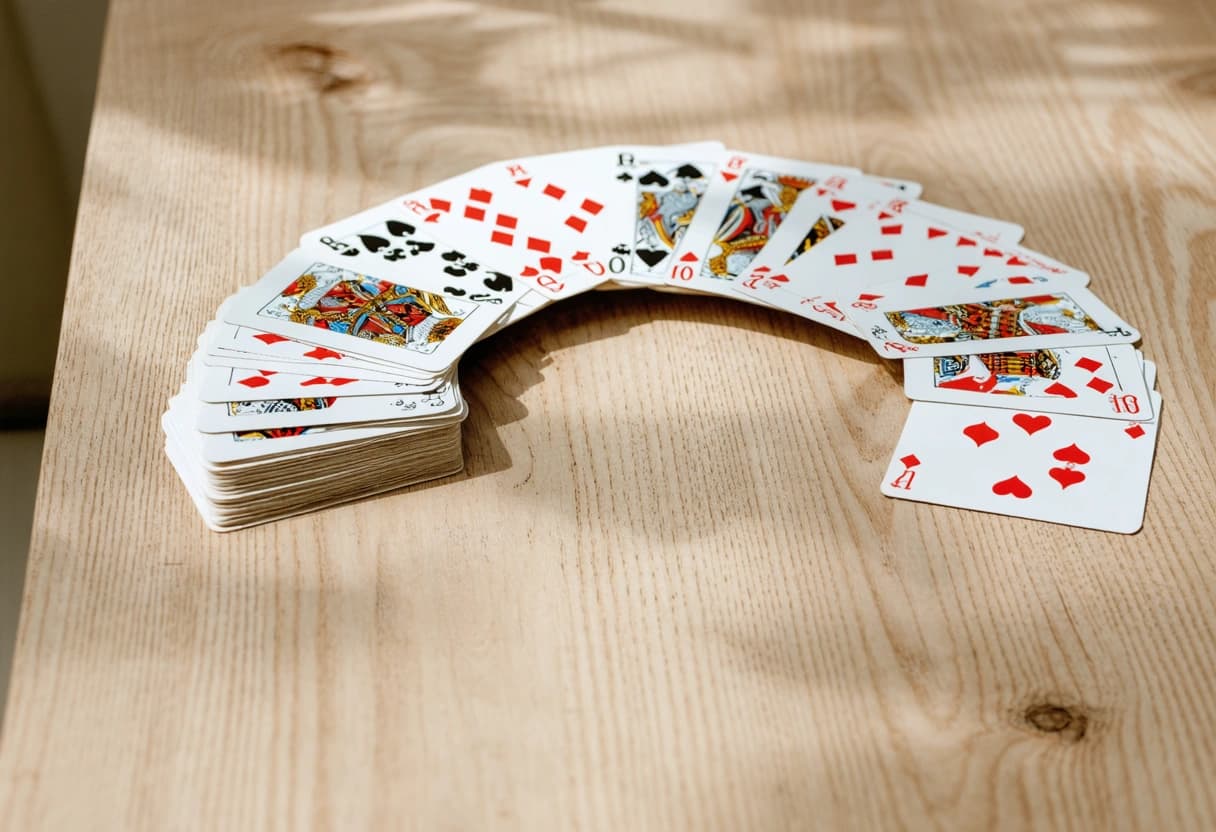
What is cartomancy?
Cartomancy refers to the art of reading the future with classic card decks — as opposed to divinatory tarot, which uses a codified deck of 78 specific cards. In France, the most common is the 32-card deck (piquet, used in many popular card games). The 52-card deck (the ordinary deck) is also widely used, especially for longer spreads.
Each card carries a symbolic meaning transmitted by oral and written tradition: the Ace of Hearts announces great joy or love, the King of Spades represents a man of authority (sometimes menacing), the Nine of Diamonds a setback or a letter, the Seven of Clubs a small amount of money. Suits have a general scope: hearts (feelings), diamonds (information, money), clubs (material, work), spades (challenges, conflicts). The cartomancer reads each card by its position in the spread and its interaction with neighbors.
The other major cartomantic tradition is the Petit Lenormand: a 36-card deck attributed to Madame Marie-Anne Lenormand (1772-1843), the celebrated cartomancer said to have advised Napoleon and Josephine. The Lenormand is more pictorial (each card represents a precise symbol: house, rider, anchor, ship), and its reading follows structured rules (notably the Grand Tableau, which uses all 36 cards at once). On Guidanza, you'll also find practitioners specialized in Lenormand cartomancy.
When to consult a cartomancer
Cartomancy particularly suits concrete everyday questions: romantic doubts, professional hesitations, expectations (a letter, news), family conflicts, daily financial questions. Less symbolic and more direct than tarot, it often gives quick answers — it's the "folk" psychic practice par excellence, consulted without lengthy preparation.
It's also widely requested for closed questions: yes/no, choice between two options ("will I move house this year?", "is this job a good decision?"). An experienced cartomancer uses a short spread (1 or 3 cards) that gives a brief answer, to be read as a tendency. That's harder to do in tarot, where each arcanum invites exploring multiple facets.
Conversely, cartomancy is less suited to deep introspective questions ("who am I really?", "what is the meaning of my life?") — for that, prefer tarot, astrology, or numerology. Good cartomancers will redirect you to another tool if your question doesn't fit cartomancy. On Guidanza, every cartomancer is vetted before activation, and you can read public reviews before booking.
How a session works
Browse the profiles of available cartomancers, compare reviews, decks used (32 cards, 52 cards, Lenormand), and the practitioner's preferred consultation mode. Pick chat or phone and a duration — cartomancy is often short (15-20 min is enough for a specific question).
After secure payment via Stripe, the session starts. You state your question. The cartomancer shuffles — focusing intention on your question — then draws cards according to the chosen spread: 3-card spread (past/present/future or situation/action/outcome), 5-card cross, 7 or 9 cards for more complex questions. For Lenormand, the Grand Tableau (36 cards) is used for a complete and lengthy reading of the overall situation.
The cartomancer interprets each card one by one, then synthesizes by accounting for associations between neighboring cards (in cartomancy, an isolated card has a meaning, two cards together have a third). You can ask several questions in the same session — it's actually common, given the format's pace. At the end, you can leave a review on the cartomancer's profile.
Cartomancy, tarot, oracles: what's the difference?
The three practices use cards but follow very different logics. Tarot follows a fixed structure of 78 cards (22 Major Arcana + 56 Minor Arcana) with codified symbolism and rich iconography (The Magician, The Empress, The Hanged Man...). It's a closed system, requiring years of practice to master. Tarot is more introspective and narrative.
Cartomancy uses ordinary playing card decks (32 or 52 cards), with symbolism transmitted by tradition. No rich iconography: just the classic figures (King, Queen, Jack) and the numbers, with meanings codified by folk culture. Cartomancy is more direct and faster — it's everyday divination.
Oracles are free-form decks: card counts vary (typically 36 to 64), and each oracle is built around a theme (angels, totem animals, goddesses, relationship situations...). The Oracle of Belline (53 cards, created in the 19th century) remains the most widely used in France. Oracles are often more intuitive to handle but offer a less structured reading.
The Petit Lenormand is technically an oracle (36 pictorial cards), but it's generally classified as cartomancy in France because it has its own tradition and spread rules. Each cartomancer lists on their profile the decks they master — check before booking.
The main cartomancy spreads
The 1-card spread is the shortest format: a single card is drawn that gives a direct answer to a simple question. Often used for the "message of the day."
The 3-card spread is the most common. Three readings are possible depending on the question: past/present/future (temporal flow), situation/action/outcome (strategic analysis), or soul/heart/body (integral reading of a person). Suits 80% of quick consultations.
The 5-card cross spread is used for more complex questions. Position 1 = the current situation, 2 = obstacles or help, 3 = what to know, 4 = the direction to take, 5 = the probable outcome. Richer but longer to interpret.
The 9-card spread (in a square, sometimes called a "simplified Celtic cross") gives a full analysis. The nine positions cover past/present/future on three planes (inner, outer, consequences). It's the format for in-depth consultations (30+ minutes).
The Grand Tableau (36 Petit Lenormand cards laid out in 4 rows of 9) is the longest and most complete spread. The cartomancer reads each card's position relative to the "person card" (the client's significator) — distances, neighborhoods, alignments. A real Grand Tableau reading lasts 45-60 minutes.
Updated on 13 October 2026
Available cartomancers
Nathalie Suteau
Tarot, Clairvoyance, Oracles
Français · English
Voyante, cartomancienne et numérologue depuis 20 ans, je suis à votre écoute pour répondre à toutes vos questions et interrogations. J’utilise des supports reconnus comme le Tarot de Marseille, l’Oracle de Belline et la numérologie. J’ai également suivi plusieurs formations, dont une formation complète Clévao avec Alexis Tournier, afin d’approfondir et structurer ma pratique. Lors d’une consultation, mon objectif est de vous apporter des réponses claires et concrètes. Je ne me limite pas à “prédire” : je vous aide aussi à comprendre une situation, à prendre du recul et à faire des choix plus justes pour vous. Je vous accompagne avec sérieux, honnêteté et bienveillance, pour vous apporter des éclairages fiables, que ce soit sur le plan sentimental, professionnel ou personnel.
Fabrice Eynolwaden
Clairvoyance, Oracles, Cartomancy
Français
Bonjour , je suis Fabrice , voyant . Depuis toujours, ma vie est guidée par une quête intérieure profonde. J’ai voyagé à travers le monde, en quête de sagesse, de rencontres et de vérités cachées. Ces voyages m’ont permis de m’ouvrir à différentes cultures, énergies et traditions spirituelles. La méditation fait partie intégrante de mon quotidien depuis de nombreuses années. Elle m’a appris à écouter le silence, à capter les vibrations subtiles et à me connecter à une guidance intérieure plus vaste que moi. Les arts martiaux ont également façonné mon chemin : discipline, équilibre, maîtrise de soi… autant de valeurs qui ont renforcé ma sensibilité et mon intuition. Aujourd’hui, je mets à profit l’ensemble de ce parcours — riche en expériences humaines, spirituelles et énergétiques — pour accompagner ceux qui cherchent des réponses, de la clarté ou un alignement intérieur. Être voyant, pour moi, c’est écouter au-delà des mots, ressentir au-delà du visible, et transmettre avec justesse ce que je perçois
Ketty Sona
Mediumship, Guidance, Clairvoyance
Français
🌸Bonjour, je suis Ketty, médium et cartomancienne Une question qui vous préoccupe ? Des doutes sur votre avenir sentimental, professionnel ou personnel ? Besoin de comprendre une situation ou simplement d'y voir plus clair ? 🤍 Je suis là pour vous apporter des réponses, un éclairage et une écoute bienveillante. A travers mes ressentis et mes supports, je canalise les messages qui vous sont destinés pour vous accompagner sur votre chemin de vie, avec sincérité, douceur et sans complaisance. ✨ Et pour commencer notre consultation, il me faut uniquement votre prénom et votre date de naissance ! Au plaisir de vous retrouver en consultation ! Ketty 🌸
Emma
Tarot, Mediumship, Pendulum
Français
Depuis 2010, je mets mes dons et mon intuition au service des autres en tant que voyante, cartomancienne et médium Passionnée par les arts divinatoires et l’accompagnement spirituel, j’ai développé une pratique basée sur l’écoute, la bienveillance et la guidance personnalisée. Médium clairvoyante, je perçois les énergies et les messages subtils afin d’éclairer les chemins de vie et d’apporter des réponses sincères à ceux qui me consultent. J’utilise également la radiesthésie avec le pendule, un outil précieux qui me permet d’affiner mes ressentis et de guider avec précision les personnes en quête de réponses. Diplômée de l’Oracle de Belline, j’accorde une place importante à cet art divinatoire reconnu pour sa richesse symbolique et sa finesse d’interprétation. Le Tarot de Marseille occupe aussi une place essentielle dans ma pratique : c’est un support que j’aime particulièrement pour sa profondeur, sa sagesse et les messages puissants qu’il transmet. À travers mes consultations, mon objectif est d’apporter clarté, réconfort et confiance, afin d’aider chacun à avancer sereinement sur son chemin de vie.
Ginie
Mediumship, Clairvoyance, Cartomancy
Français
Je suis Ginie, médium, clairvoyante et clairaudiente de naissance. Depuis toujours, je perçois les énergies, les émotions et les informations qui échappent parfois au regard ordinaire. Au fil des années, j'ai développé mes facultés intuitives afin de les mettre au service de celles et ceux qui ressentent le besoin d'être guidés, rassurés ou éclairés dans une période de questionnement. Lors de nos consultations, je m'appuie sur mes ressentis, ma médiumnité ainsi que sur mes oracles et mon pendule pour affiner les messages que je reçois. Ces outils me permettent de mieux comprendre les situations que vous traversez, d'identifier les blocages qui peuvent freiner votre évolution et de mettre en lumière les opportunités qui s'offrent à vous. Je vous accompagne avec sincérité et bienveillance dans tous les domaines de votre vie : l'amour, les relations sentimentales et familiales, les choix professionnels, les projets personnels ou encore les périodes de doute et de transition. Mon objectif n'est pas de vous dire ce que vous souhaitez entendre, mais de vous transmettre avec honnêteté les informations qui me parviennent afin de vous aider à prendre les meilleures décisions pour votre avenir. Chaque consultation est un moment d'échange privilégié où vous pouvez vous exprimer librement, sans jugement. Je mets un point d'honneur à vous offrir une guidance claire, précise et respectueuse, dans un climat de confiance et d'écoute. Si vous recherchez un éclairage sincère sur votre situation actuelle, des réponses à vos interrogations ou simplement un accompagnement pour avancer avec davantage de sérénité, je serai heureuse de vous guider sur votre chemin. Ensemble, faisons la lumière sur les réponses que votre âme cherche à entendre.
Nélia
Mediumship, Oracles, Cartomancy
Français
✨ Nélia – Médium intuitive et clairaudiente • Des perceptions présentes depuis l’enfance, développées au fil de 11 années de pratique ✨ Mes capacités extrasensorielles ainsi que mon parcours spirituel m'ont amenée à développer mes facultés médiumniques, notamment mon intuition et ma clairaudience. J'exerce ces pratiques depuis plus de 10 ans. J'utilise différents supports et arts divinatoires (cartomancie, radiesthésie, écriture automatique/intuitive) qui vont permettre "d'enclencher" la communication, néanmoins la majeure partie des éléments viennent de mon intuition et/ou de la clairaudience. Je n’ai pas de méthode précise pour procéder. Je m’adapte aux besoins de chaque personne, en m'appuyant sur mes ressentis avant tout. Je traite le domaine sentimental / professionnel / familial / financier. Mon approche repose sur l'écoute, la bienveillance et l'authenticité. Cependant je ne suis pas pour autant dans la complaisance. Je vous transmets les messages et perceptions qui se présentent à moi, dans le respect de votre libre arbitre, afin de vous accompagner sur votre chemin de vie.✨
Lesoindesoi
Pendulum, Cartomancy, Energy Work
Français
Je suis Charlotte, cartomancienne et énergéticienne depuis 13 ans. J’aime utiliser les cartes comme un miroir, pas comme une vérité toute faite. À travers mes guidances, je mêle intuition, lecture des cartes et ressentis pour vous aider à mettre des mots et de la clarté sur ce que vous traversez. Amour & relations • Travail & projets • Changements • Énergies du moment • Questions personnelles ATTENTION PAS DE QUESTION AUTOUR DE LA SANTÉ OU DE GROSSESSE Pas de jugement, pas de fatalité : juste un éclairage sincère pour vous aider à y voir plus clair. Vous gardez toujours votre libre arbitre. Moi, je vous transmets ce que les cartes ont à vous montrer.
Petitefee84
Mediumship, Clairvoyance, Oracles
Français
✨ Bienvenue dans mon petit monde à part✨ Je suis Petitefee84, médium pure canal, clairvoyante, clairaudiente, cartomancienne et énergéticienne. Si vous êtes ici pour faire une pause dans votre présent parfois tumultueux, alors vous êtes au bon endroit. 💜 Installez-vous confortablement, prenons le temps d'échanger et laissez-moi vous accompagner avec douceur, sincérité et bienveillance. Mes capacités médiumniques se sont manifestées il y a plus de 20 ans, à la suite d'un profond choc émotionnel qui a bouleversé mon existence et éveillé mes perceptions spirituelles. Depuis, j'ai appris à accueillir et à développer ma médiumnité, ma clairvoyance, ma clairaudience et mes capacités de canalisation. Je pratique la médiumnité et la voyance pure, avec ou sans support. Lorsque j'utilise mes oracles, ils me servent de point de départ pour laisser venir mes flashs, mes ressentis, les images, les symboles et parfois même les odeurs que je perçois. À travers mes canalisations, les messages que je reçois intuitivement de mes guides et de mes anges, ainsi que ce que j'entends grâce à ma clairaudience, je vous propose un éclairage sur vos interrogations sentimentales, familiales, professionnelles et personnelles. Je travaille avec sérieux, honnêteté, respect et sans complaisance. Je ne suis pas là pour vous dire ce que vous souhaitez entendre, mais pour vous transmettre avec sincérité les messages et les ressentis que je perçois. Chaque consultation se déroule dans la confidentialité, sans jugement et dans le respect absolu de votre libre arbitre. Vous ne me trouverez pas avec une baguette magique, mais toujours avec un sourire, une écoute attentive et le cœur ouvert. 🥰 Mon souhait est de vous aider à retrouver de la clarté, de la confiance et de la sérénité pour avancer sur votre chemin, tout en restant maître de vos propres décisions. 💜 Transmettre avec le cœur, pratiquer avec humilité, accompagner avec bienveillance. Je vous remercie infiniment pour votre confiance et vous dis à très vite pour un moment de partage, d'écoute et de bienveillance. 🥰🙏❤️ ✨ Petitefee84
Erwann Medium
Mediumship, Clairvoyance, Pendulum
Français
Des ressentis sincères, une écoute attentive et un éclairage personnalisé sur votre chemin de vie. Depuis plusieurs années, je mets mes ressentis et mes capacités médiumniques au service de celles et ceux qui souhaitent comprendre une situation, trouver des réponses à leurs interrogations ou porter un regard différent sur leur avenir. Médium et voyant, je travaille principalement avec mon intuition, mes ressentis et le tarot. Ma sensibilité peut également m'orienter vers la communication avec les défunts et l'écriture automatique, lorsque ces perceptions se présentent au cours d'une consultation. ❤️ Le domaine sentimental est au cœur de mes consultations. Vous vous interrogez sur les sentiments d'une personne, ses intentions ou l'évolution de votre relation ? Vous attendez un retour, un message ou un rapprochement ? Vous traversez une séparation, une relation compliquée ou une période de doute ? Je vous accompagne dans ces questionnements afin de vous apporter un éclairage sur votre situation, les liens qui vous unissent à une personne et les perspectives que vous souhaitez explorer. Je peux également vous accompagner dans les domaines familial, professionnel, personnel et spirituel mais aussi la justice ✨ Ma priorité : la sincérité et la bienveillance. Chaque histoire est unique et mérite une attention particulière. Je prends le temps de vous écouter, de comprendre votre demande et de vous transmettre mes ressentis avec honnêteté, sans jugement et avec le plus grand respect. Je ne cherche pas à vous dire uniquement ce que vous souhaitez entendre. Lorsque mes perceptions diffèrent de vos attentes, je préfère vous les partager avec tact et transparence. Pour moi, une consultation doit vous permettre de prendre du recul, d'y voir plus clair et d'avancer avec davantage de sérénité. Je respecte votre libre arbitre, car vos choix vous appartiennent et votre avenir ne se résume pas à une prédiction. 🔮 Vous avez des questions ? Prenons le temps d'en parler. Que vous traversiez une période d'incertitude, que vous cherchiez à comprendre une relation ou que vous ressentiez simplement le besoin d'être éclairé(e), je vous accueille avec sérieux, disponibilité et bienveillance. Venez avec votre prénom, votre question et votre histoire. Je serai heureux de vous accompagner et de vous transmettre mes ressentis avec authenticité. Au plaisir de vous retrouver prochainement en consultation.
Anna
Mediumship, Oracles, Guidance
Français
Bonjour, Je m'appelle Anna, Medium pure et cartomancienne. Médium depuis mon plus jeune âge venant de ma grand-mère maternelle, je ressens les choses et les vibrations qui me permettent de vous répondre. Mon guide est ma maman. Guider les personnes dans la vie est ma vocation, ma passion. Quelque soit votre question, j'y réponds avec sincérité et sans complaisance mais dans la bienveillance. Je ne souhaite que votre bonheur et votre réussite. Mes prédictions sont datées du mieux possible une date, un mois, une saison... Je vous réponds par flashs et avec mon merveilleux jeu de cartes ! N'hésitez plus, je suis là pour vous. A très vite ! Anna
Sigrid
Tarot, Oracles, Pendulum
Français
Besoin d’y voir plus clair ? Une question vous préoccupe, votre cœur hésite ou une décision vous semble difficile à prendre ? Je suis Nayla, cartomancienne passionnée, et je vous accompagne avec bienveillance à travers les messages des cartes pour vous apporter un éclairage, des réponses et une nouvelle perspective sur votre situation. 💗 Spécialiste des questions sentimentales, je vous accompagne lorsque vous vous interrogez sur une relation, sur les sentiments d’une personne, sur votre avenir amoureux ou lorsque vous traversez une période de doute dans votre vie affective. Mais l’amour n’est pas le seul chemin que nous pouvons explorer. Choix professionnels, décisions importantes, changements de vie, périodes de questionnement ou besoin de comprendre une situation : les cartes peuvent vous aider à prendre du recul et à retrouver confiance en votre propre intuition. 🌙 Mon objectif : vous offrir un moment d’écoute, de douceur et de clarté, sans jugement, afin que vous puissiez avancer plus sereinement sur votre chemin. Une question vous tient à cœur ? Une situation vous empêche d’avancer ? Laissez moi vous aider à regarder les choses sous un autre angle.
Délia
Mediumship, Clairvoyance, Cartomancy
Français
Bonjour, Je m'appelle Délia, je suis énergéticiene, medium et voyante. J' utilise les cartes et le pendule en plus de mes ressentis pour répondre au mieux à vos interrogations. La voyance fait partie de ma vie depuis très longtemps peut-être même toujours...Je suis la pour vous guider au mieux. En début de consultation j ai besoin du nom, prénom et date de naissance de chaque personne concernée, je vous en remercie d avance. Je tiens à préciser que je ne pratique pas de complaisance mais je suis toujours dans l écoute et l'empathie avec la personne qui s'adresse à moi. Il est bien de dire aussi qu'il peut arriver que je n ai pas plus d informations que cela sur la situation demandée et dans ce cas je le dis tout simplement. L'authenticité, la sincérité sont importantes pour moi. D autre part, je préfère prévenir que pour faire la voyance, que ce soit au téléphone, par tchat, mail ou sms j ai parfois besoin de prendre mon temps car je privilégie la qualité plutôt que la rapidité. Point important à savoir : je n'aborde pas les sujets de maladie et de mort. Je vous dis à bientôt et vous souhaite une belle journée. Délia.
Frequently asked questions
What's the difference between cartomancy and tarot?▾
Tarot uses 78 symbolic cards with rich iconography (Major and Minor Arcana). Cartomancy uses classic playing card decks (32 or 52 cards). Tarot is more introspective and narrative; cartomancy is generally more direct and everyday-oriented.
Which deck is used in cartomancy?▾
In France the most common is the 32-card (piquet) deck. You'll also find 52-card decks, the Petit Lenormand (36 cards), and regional decks. Each cartomancer lists on their profile the decks they practice.
Can I ask a yes/no question?▾
Yes: cartomancers then use a simple spread (1 or 3 cards). The answer remains a tendency, not a certainty, and an open question often yields a richer reading.
How long does a cartomancy session last?▾
From 5 minutes by phone with the discovery session (10 minutes by chat), then 10, 20, 30, 45 or 60 minutes. Sessions are often short (15-20 minutes) because answers are more direct than in tarot. For a full Lenormand Grand Tableau, count 45-60 minutes.
Can cartomancy predict the future?▾
It gives tendencies and clues about a situation, like all forms of psychic reading. It's not an exact science, and a good cartomancer will say so. It's particularly well suited to short-term questions (weeks, a few months).
What is the Petit Lenormand?▾
A 36-card pictorial deck attributed to Madame Marie-Anne Lenormand (1772-1843), the celebrated cartomancer said to have advised Napoleon. Each card represents a precise symbol (house, rider, anchor, ship) and the reading follows structured rules.
How much does a cartomancy session cost?▾
Cartomancers set per-minute rates. Prices start at €1.80 per minute and vary depending on experience. Given the format's speed, total costs are often affordable. No subscription, no commitment.
Can I ask several questions in the same session?▾
Yes, it's very common in cartomancy. Given the format's pace, many clients chain 2-3 different questions (love, work, family) in the same session. The cartomancer adapts the spread to each question.
Related specialties
Other practices that might answer your question.
Related terms
Useful definitions to better understand this practice.