Online tarot readings with verified professional tarologists
Tarot, a card game that appeared in the 15th century, has been used for divination since the late 18th century. On Guidanza, you consult independent, vetted tarologists who perform your readings live via chat or phone — no subscription, no commitment.
View available practitioners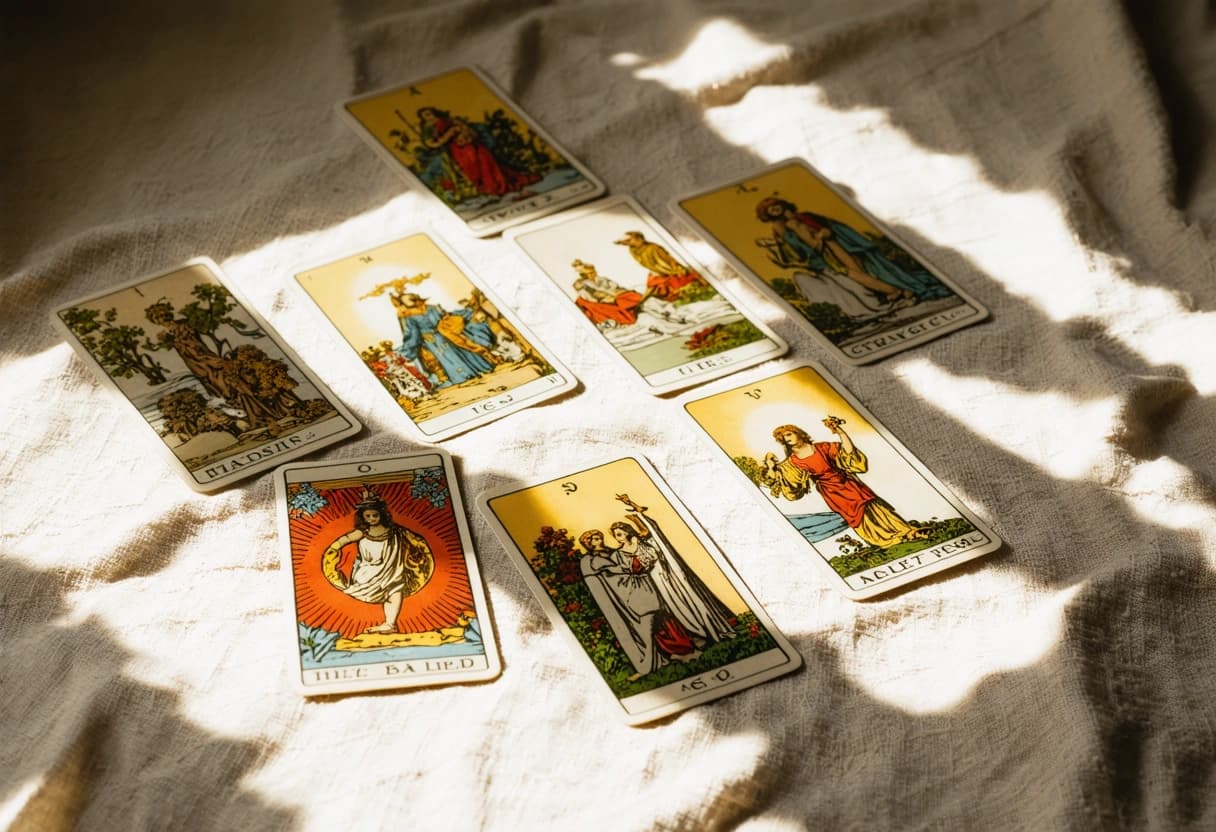
What is tarot?
Tarot uses a 78-card deck — 22 Major Arcana (symbolic cards like The Magician, The Empress, The Wheel of Fortune) and 56 Minor Arcana split across four suits (Cups, Pentacles, Swords, Wands). Each card carries its own meaning, but the sense of a reading emerges from the combination and position of the cards relative to each other.
Tarologists use several types of spreads depending on the question: the Celtic Cross (10 cards, full overview), the three-card spread (past/present/future, or situation/action/outcome), and the grand tableau (up to 21 cards for an in-depth reading). Interpretation never boils down to reading each card in isolation — it's the art of weaving a coherent narrative from the drawn symbols and how they interact.
Several decks coexist. The Marseille Tarot, formalized in the 17th century and popularized in recent decades by Philippe Camoin and Alejandro Jodorowsky, remains the French reference. The Waite-Smith deck (known as Rider-Waite, 1909, illustrated by Pamela Colman Smith) is the most common in English-speaking countries. The Persian Tarot (55 cards) focuses on love and relationships; the Oracle of Belline and the Thoth deck (created by Aleister Crowley) complete the picture. Each tarologist lists their preferred deck on their profile.
When should you consult a tarologist?
A tarot reading is particularly useful during transition periods: career moves, relationship crossroads, breakups in progress, relocations, financial questions, or important life decisions. Tarot doesn't predict the future with certainty — it highlights the forces at play, the obstacles, the available resources, and the possible paths forward. It's a perspective-taking tool, not a crystal ball.
Many clients also consult without a specific question, simply to take stock of their overall situation. An annual or seasonal reading can reveal emerging themes you weren't consciously aware of. Conversely, tarot is less suited to strictly medical, legal or material questions (exact figures, specific dates): for those topics, consult a professional in the relevant field.
Reputable tarologists follow a clear ethical code: they never replace a doctor, a lawyer or a therapist, and they redirect to those professionals when needed. On Guidanza, every tarologist is vetted before activation, and you can read public reviews from previous clients before booking.
How a tarot consultation works
Browse the profiles of available tarologists, compare reviews, rates, and decks used, then pick the tarologist that fits. Choose your consultation mode — live chat to keep a written record, or phone for a more spontaneous exchange — and the duration (from 10 minutes to an hour, or 5 minutes by phone with the discovery session).
After secure payment via Stripe, the session starts at the scheduled time. You state your question: the tarologist draws the cards, describes each arcane, then shares their interpretation taking into account the position and relationships between the cards. The exchange is interactive — you can ask for clarifications, follow-up questions, or build on something that resonates.
At the end of the consultation, you can leave a public review on the tarologist's profile. That rating matters as much for the community as for the tarologist: it builds collective trust and helps future clients choose. No subscription, no commitment — you pay only for the session you booked.
Preparing for your tarot session
The quality of a consultation depends a lot on how you approach it. Before booking, take a few minutes to formulate your question. An open question ("What should I understand about this situation?") usually yields a richer reading than a closed one ("Will I get this promotion?"). If you're unsure, many tarologists will help you reformulate it at the start of the session.
Pick a quiet moment, in a place where you won't be interrupted. For a phone consultation, plan to use headphones — speakerphone degrades the intimacy of the exchange. For chat, open the window in a dedicated tab, with notifications silenced in the background — you'll be more present to what's being said.
Come with a clear intention but stay open. Tarot works best when you listen for what emerges, rather than seeking validation for a decision you've already made. Note the key elements of the reading during the consultation — you'll probably revisit them in the following days, and some symbols only fully reveal their meaning in hindsight. Don't hesitate to ask the tarologist to repeat or clarify a point: it's your time.
Tarot, oracles and cartomancy: what's the difference?
Tarot, oracles, and cartomancy are often confused but follow different logics. Tarot has a fixed structure of 78 cards (22 Major + 56 Minor) with codified symbolism — it's a closed system, requiring years of practice to master.
Oracles, by contrast, are free-form decks: the number of cards varies (typically between 36 and 64), and each oracle is built around a particular theme (angels, totem animals, goddesses, archetypes...). The Oracle of Belline (53 cards, created in the 19th century by the magus Edmond) remains the most widely used in France. Oracles are often more intuitive to handle than tarot but offer a less structured reading.
Cartomancy refers more broadly to the art of reading the future with any deck of cards, including a regular 32-card playing deck. Madame Lenormand, the celebrated 19th-century cartomancer, popularized this practice; the 36-card Lenormand deck bears her name. Psychics specialized in pure cartomancy generally don't use tarot.
On Guidanza, you can also consult readers specialized in oracles or cartomancy depending on the type of reading you're after. Each practice has its strengths: tarot for in-depth analysis, oracles for thematic guidance, cartomancy for direct everyday questions.
Updated on 13 October 2026
Available tarologists

Julien Gabriel
Mediumship, Tarot, Oracles
Français
Bonjour, je suis Julien Gabriel, Médium pur et Tarologue. Dès mon plus jeune âge, j'ai eu des flashs. Mon arrière-grand-mère, qui était médium, m'a appris à canaliser mon don et mon empathie simplement en utilisant un jeu de 32 cartes. Par la suite, à l'adolescence, j'ai eu mon premier tarot et mon premier oracle. Ensuite, j'ai rencontré une personne qui exerçait comme voyante avec une solide expérience, qui m'a fait découvrir la divination grâce au marc de café. Ces différents supports me servent de piste de décollage lors de mes voyances. Ils me permettent également de confirmer mes ressentis et mes flashs. Cela empêche d'entrer en télépathie et de dire ce que les consultants souhaiteraient entendre. Au fur et à mesure des années, j'ai procédé à des consultations auprès de mes proches ainsi qu’à leurs amis et ainsi de suite. C'est ce qui m'a poussé à ouvrir mon cabinet : vous aider est ma plus sincère intention. Comment se déroule une consultation et quel sujet abordé ? J'ai besoin de votre prénom (le vrai surtout) et de votre date de naissance ainsi que des personnes concernées Quels que soient la question et le domaine concerné, je suis là pour vous donner les possibilités et les solutions qui se présenteront devant vous, en toute humilité et sans complaisance. En effet, je dis réellement ce que je vois et il est possible que parfois les prédictions ne soient pas celles que vous souhaitez entendre. Je peux le comprendre mais mon éthique m'interdit de modifier ce que je vois. Attention, je ne suis pas un gourou : vous conservez votre libre-arbitre concernant les décisions de votre vie et êtes le seul acteur de votre destin. Précision concernant les dates : Nous souhaitons tous avoir des réponses précises et datées, cependant la datation est un exercice compliqué et quasi-impossible en voyance car certaine de nos actions crée des blocages qui retardent les événements C’est pourquoi, par honnêteté, je vous donnerai plus des périodes ou des saisons de réalisation de ces prédictions, mais tout arrive quand on est réellement prêts pas quand on le pense Au plaisir de vous entendre ! Julien Gabriel
Nathalie Suteau
Tarot, Clairvoyance, Oracles
Français · English
Voyante, cartomancienne et numérologue depuis 20 ans, je suis à votre écoute pour répondre à toutes vos questions et interrogations. J’utilise des supports reconnus comme le Tarot de Marseille, l’Oracle de Belline et la numérologie. J’ai également suivi plusieurs formations, dont une formation complète Clévao avec Alexis Tournier, afin d’approfondir et structurer ma pratique. Lors d’une consultation, mon objectif est de vous apporter des réponses claires et concrètes. Je ne me limite pas à “prédire” : je vous aide aussi à comprendre une situation, à prendre du recul et à faire des choix plus justes pour vous. Je vous accompagne avec sérieux, honnêteté et bienveillance, pour vous apporter des éclairages fiables, que ce soit sur le plan sentimental, professionnel ou personnel.
Maxime Jocelyn
Tarot, Astrology, Mediumship
Français
Bonjour et bienvenue, Je suis Maxime, médium, tarologue et astrologue. Depuis tout jeune je ressens les energies des personnes avec qui je suis en contact et je transmet aussi l'état d'esprit des personnes sur lesquelles vous vous questionnez. Je pratique les arts divinatoires depuis 30 ans et vous accompagne depuis 15 ans dans votre évolution sentimentale, professionnelle et spirituelle. Voyance pure et lecture des tarots pour mieux vous guider à travers vos questionnements. Tous les sujets sont bienvenus, abordés selon la déontologie et sans complaisance. NB : Je suis régulièrement consulté par mes collègues :) Je vous attends pour une consultation de qualité. À très vite Maxime
Célia
Tarot, Energy Work, Clairvoyance
Français
Célia Luigi exerce depuis 30 ans, avec comme supports le Tarot de Marseille ( mon principal allié), des Oracles et le pendule,ainsi que mes ressentis spontanés. J'exerce en parallèle un métier médico social ( auprès d'un public en situation de Handicap), mon équilibre s'est formé ainsi au fil du temps.. J'aime la franchise, je ne suis pas infaillible, mais je tiens à garder mon authenticité en disant les choses clairement..et vous gardez votre libre arbitre. Il est quasiment impossible de " dater les évènements" et je conseille de noter mes prédictions. Bienvenue dans mon Univers, c'est avec plaisir que je serais là pour vous aider..
Nael
Mediumship, Oracles, Tarot
Français
Spécialités : Nael a reçu un don : celui de « Médium » . Grâce à ce don, Nael peut intervenir dans tous les domaines de la vie, et elle pourrait sans difficulté, s’occuper des vedettes, des stars ou des grands de ce monde. Mais Nael préfère mettre ses dons au service des plus démunis. Qualifications : Nael s’est rendu compte de son dons, dès son enfance, en faisant des « prévisions » toujours précises de ce qui allait arriver dans son entourage familial ou amical. Peu à peu, son dons qui lui a été octroyé, s'est transformé en une vocation irrésistible : Apporter son aide à tous ceux et à toutes celles qui le lui le demandent et qui en ont besoin. Expériences : Après de nombreuses années d’exercice, la renommée de Nael est naturellement venue toute seule, par le simple bouche-à-oreille, car Nael agit en toute discrétion, sans publicité. Et si elle continue d’exercer, c’est parce qu’ « elle sait » que ce n’est pas par hasard que ses dons lui ont été transmis, mais parce que son destin lui commandait de venir en aide aux autres, et, les lettres de témoignages et d’encouragement qu’elle reçoit tous les jours, sont ses plus belles récompenses. Personnalité : Nael est Capricorne, et vous pouvez compter sur toute la détermination de cette battante « au grand cœur », pour vous venir en aide, quelle que soit la difficulté de votre problème. Elle sera toujours à votre écoute, avec la plus grande attention, et elle saura vous indiquer les meilleurs chemins possibles pour vous guider vers votre Bonheur.

Ketty Sona
Mediumship, Guidance, Clairvoyance
Français
🌸Bonjour, je suis Ketty, médium et cartomancienne Une question qui vous préoccupe ? Des doutes sur votre avenir sentimental, professionnel ou personnel ? Besoin de comprendre une situation ou simplement d'y voir plus clair ? 🤍 Je suis là pour vous apporter des réponses, un éclairage et une écoute bienveillante. A travers mes ressentis et mes supports, je canalise les messages qui vous sont destinés pour vous accompagner sur votre chemin de vie, avec sincérité, douceur et sans complaisance. ✨ Et pour commencer notre consultation, il me faut uniquement votre prénom et votre date de naissance ! Au plaisir de vous retrouver en consultation ! Ketty 🌸
Emma
Tarot, Mediumship, Pendulum
Français
Depuis 2010, je mets mes dons et mon intuition au service des autres en tant que voyante, cartomancienne et médium Passionnée par les arts divinatoires et l’accompagnement spirituel, j’ai développé une pratique basée sur l’écoute, la bienveillance et la guidance personnalisée. Médium clairvoyante, je perçois les énergies et les messages subtils afin d’éclairer les chemins de vie et d’apporter des réponses sincères à ceux qui me consultent. J’utilise également la radiesthésie avec le pendule, un outil précieux qui me permet d’affiner mes ressentis et de guider avec précision les personnes en quête de réponses. Diplômée de l’Oracle de Belline, j’accorde une place importante à cet art divinatoire reconnu pour sa richesse symbolique et sa finesse d’interprétation. Le Tarot de Marseille occupe aussi une place essentielle dans ma pratique : c’est un support que j’aime particulièrement pour sa profondeur, sa sagesse et les messages puissants qu’il transmet. À travers mes consultations, mon objectif est d’apporter clarté, réconfort et confiance, afin d’aider chacun à avancer sereinement sur son chemin de vie.
Sigrid
Tarot, Oracles, Pendulum
Français
Besoin d’y voir plus clair ? Une question vous préoccupe, votre cœur hésite ou une décision vous semble difficile à prendre ? Je suis Nayla, cartomancienne passionnée, et je vous accompagne avec bienveillance à travers les messages des cartes pour vous apporter un éclairage, des réponses et une nouvelle perspective sur votre situation. 💗 Spécialiste des questions sentimentales, je vous accompagne lorsque vous vous interrogez sur une relation, sur les sentiments d’une personne, sur votre avenir amoureux ou lorsque vous traversez une période de doute dans votre vie affective. Mais l’amour n’est pas le seul chemin que nous pouvons explorer. Choix professionnels, décisions importantes, changements de vie, périodes de questionnement ou besoin de comprendre une situation : les cartes peuvent vous aider à prendre du recul et à retrouver confiance en votre propre intuition. 🌙 Mon objectif : vous offrir un moment d’écoute, de douceur et de clarté, sans jugement, afin que vous puissiez avancer plus sereinement sur votre chemin. Une question vous tient à cœur ? Une situation vous empêche d’avancer ? Laissez moi vous aider à regarder les choses sous un autre angle.
Angelica
Tarot, Pendulum, Cartomancy
Français
Cartomancienne , Voyante et Tarologue depuis plus de 16 ans Je pratique aussi le pendule et la communication animale J'utilise les cartes (Oracles et tarot) comme support pour appuyer mes ressentis :" Les cartes ne mentent jamais, elles éclairent ce que votre destin voudrait vous dire". Mes tirages et mes guidances vous apportent des éclairages précieux pour vous permettre d'évoluer personnellement et vous transmettent les messages dont vous avez besoin pour avancer avec plus de clarté.
Gladys médium
Tarot, Mediumship, Oracles
Français
Medium de naissance depuis trois générations. Tarologue, soins énergétique, pendule.
L'Âme Lumineuse
Tarot, Cartomancy, Guidance
Français
✨ L’Âme Lumineuse ✨ Cartomancienne et praticienne en radiesthésie, j’accompagne chaque personne avec écoute, bienveillance et discrétion. À travers mes consultations, je vous propose un éclairage sur vos questionnements, vos émotions et les différentes possibilités qui peuvent se présenter à vous. Mon approche repose sur une écoute attentive et personnalisée. Chaque consultation est unique et adaptée à votre situation, sans jugement et dans le respect de votre histoire. Mon objectif est de vous offrir un moment d’échange, de réflexion et de guidance, afin de vous aider à prendre du recul et à avancer plus sereinement. ✨ Bienvenue dans l’univers de L’Âme Lumineuse. ✨
Chelsea
Tarot, Cartomancy, Oracles
Français
Voyante et cartomancienne, je vous accompagne avec écoute, intuition et précision, à travers le Tarot de Marseille et l'Oracle de la Triade. Je pratique la cartomancie depuis plusieurs années. J'accorde une grande importance à l'écoute de chaque personne et à la compréhension de sa situation. Mes consultations sont personnalisées, confidentielles et sans jugement. Je peux vous accompagner sur différentes thématiques : amour et relations travail et projets choix personnels évolution finances questions générales À travers les cartes, je vous propose un éclairage sur votre situation et sur les possibilités qui peuvent se présenter à vous. Mon approche est à la fois intuitive et structurée : il s'agit de vous apporter une lecture claire, adaptée à vos questionnements.
Frequently asked questions
Can tarot really predict the future?▾
Tarot is not an exact science and should not be treated as a guaranteed prediction. Reputable tarologists frame their readings as insight into a situation, a guide for reflection — not absolute truth. It's a decision-support and perspective-taking tool.
How long does a tarot reading take?▾
The shortest format on Guidanza is the 5-minute discovery session, by phone (chat starts at 10 minutes); then 10, 20, 30, 45 or 60 minutes. Most tarot readings run between 10 and 30 minutes depending on the complexity of the question and the number of cards being interpreted.
What's the difference between Marseille Tarot and Persian Tarot?▾
The Marseille Tarot (78 cards) is the most universal deck — it covers all topics. The Persian Tarot (around 55 cards) is focused on love and relationships. Every tarologist lists the decks they use on their profile.
How much does a tarot reading cost?▾
Tarologists set their own per-minute rates. Prices start at €1.80 per minute and vary depending on the tarologist's experience. The total is shown before payment — no hidden fees, no subscription, no commitment.
Can I read tarot cards myself?▾
Yes, many people learn tarot for personal use. That said, interpretation takes years of practice — a professional reads not just each card but the relationships between them, which is hard to replicate on your own.
How do I phrase a good question for a tarot reading?▾
Open questions work better than closed ones: "How can I move forward in this situation?" will yield a richer reading than "Will I change jobs this year?". Avoid yes/no formulations and favor wording that invites exploration. If you're unsure, ask the tarologist to rephrase the question with you at the start of the session.
How often should I consult a tarologist?▾
There's no absolute rule. Most clients come at key moments (career transitions, romantic doubts, important decisions), not as a routine. Consulting too often can foster dependency and cloud your own intuition — the best tarologists will remind you of that themselves.
Is tarot compatible with my beliefs?▾
Tarot is a cultural and symbolic tool, not a religious object. Most clients use it independently of their spiritual convictions. Some religious traditions (traditional Catholicism, Islam, Orthodox Judaism) discourage it; others integrate it without issue. It's a personal question — everyone remains free to practice or not based on their own convictions.
Related specialties
Other practices that might answer your question.


Related terms
Useful definitions to better understand this practice.